Sunday, May 17, 2015

Looking Up

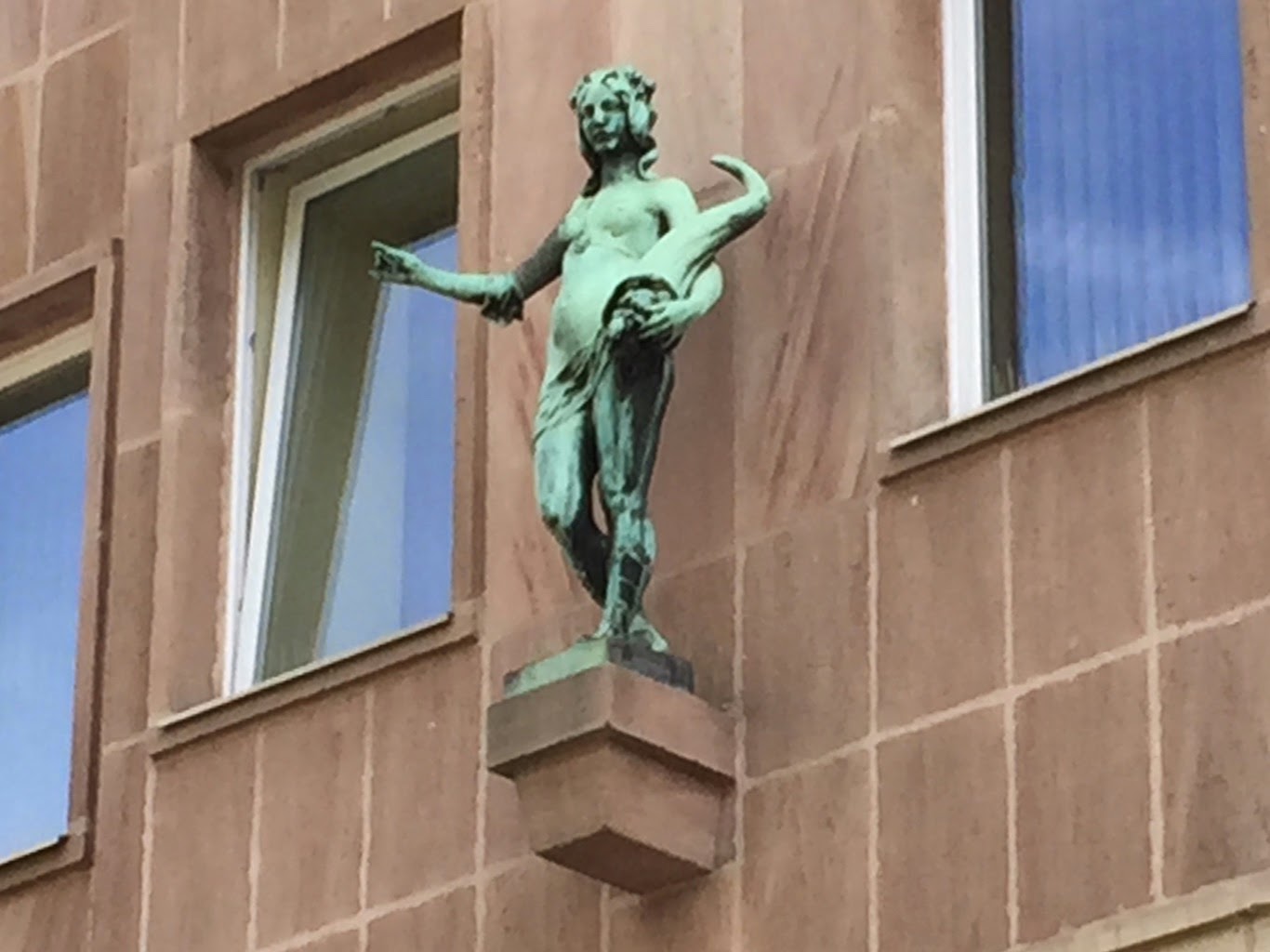
Saint on top of Santa Anna chapel in Obernburg
During our trip to Franconia, I was especially struck by the many things you could see while looking up. Even though at Middle Franconia is now protestant, south Germany in general has been catholic for longer and you see saints and other figures tucked away everywhere. Above, a female sent whose name I forgot on top of the Saint Anna chapel in Obernburg. She holds a snake, fairly unusual.

Several Choerlein in Nuernberg

Another Looking Up sight are the many Choerlein, small or large chancels, that are typically found especially in Nuernberg. There's a whole web page devoted to them. The Choerlein were ostensibly used as small chapels starting in the 15th century. However, many of the wealthy merchants used them primarily to show off. Other ornamentation of houses was restricted to the noblemen, so the merchants used the Choerlein as the BMW (or Porsche) of the day.


Once I started looking up, I couldn't stop. Sculptures large and small were everywhere. Some of them old, some of them quite new. 


I should add that this is a city phenomenon - the two-story houses commonly found in small towns or villages don't have sculptures (instead, you can find small altars at various places, especially in southern Germany).


Strangely, the sculptures don't necessarily have a lot to do with the shops that are on the ground floor of the houses - above, a sculpture at the pharmacy house.


And here, a very impressive St. George and the Dragon very close to the Nuernberg castle. Note the little roof above St. George's head. Even in churches the sculptures of saints always have a roof, mere mortals don't get roofs.


As is illustrated also by this beautiful sculpture of (I think) Mary at the second floor level of a store that sells traditional clothing (Trachten) in Nuernberg.

I'll keep looking up - and we'll find that looking up in Berlin, a much younger city, will yield different results. 

Friday, May 15, 2015

Trip to Lower Franconia


Medieval Gate in Obernburg


 Posted by James


Last week, Renate and I did a trip to Franconia to visit with our brother-in-law in Nuremberg and to attend Renate's high school class reunion in Erlenbach. Whether the trip would go forward at all was a bit touch and go. The locomotive engineers declared a strike, the third time I think since the beginning of the year, due to a power dispute and a dispute about time off. But the Deutsche Bahn arranged for substitute trains, and we took one over Hannover to Nuremberg, where our brother-in-law lives.

On the way to the train station by taxi (since the S Bahn was only running every twenty minutes due to the strike) we saw this young woman standing out in the middle of the street performing a juggling act in front of cars waiting for a traffic light to turn green:

which seemed kind of a prototypical Berlin Moment.

The trip took about an hour longer than expected, with an hour layover in Hannover. Along the way, we had a good look at evidence of Germany's "Energiewende". Germans call the time in 1989-1991 when the Berlin Wall came down and the two halves of German reunited "Die Wende", the Change or the Transformation. In 1988, nobody ever thought it would be possible for Germany to reunite, even though it was a dream of the people on both sides since the end of WWII and even enshrined in the West German constitution. In the early 2000s, the government decided to apply the same principle to energy, and so called it "Die Energiewende", the Energy Transformation. Germany now gets more than 30% of its energy from renewable sources, many of them wind machines like these along the train route in north Germany:
You see wind machines everywhere out in the countryside, and solar panels on many people's roofs. While some people don't like what the wind machines do to the views of the landscape, before the wind machines went up, there were factory smokestacks in towns and of course the ubiquitous power pylons everywhere. Climate change isn't a political issue in Germany, the only political issue has been how to address it, in particular whether Germany's nuclear power plants should be shut down. That was settled when the two reactors at Fukushima melted down in 2011, and now the plan is to site wind machines in the North Sea and run DC power lines (to reduce losses) to south Germany where much of the industry is located.

The Energiewende is still a work in progress. Brown coal power plants have made a comeback because they are the only kind of fossil fuel power that is cheap enough to compete with renewables. Unlike the US, gas comes from Russia and is typically only used for home heating and industrial heat. But the important point is that German society has made the commitment and the necessary laws and regulations are being put in place as needed. The laws and regulations shape the business and economic environment to slowly move German society away from fossil fuel and towards renewables.

In Nuremberg, we stopped briefly to borrow a car from our brother-in-law and say hi to one nephew, who was headed out for a month on an auto rally. Then we drove to the lower Main River Valley, or Lower Franconia as it is known ("Unterfranken" in German). Franconia (Upper, Middle, and Lower) is the most southern part of the state of Bavaria, and the Franconians are always complaining about the Bavarians: all the money goes to Munich and Upper Bavaria, the nicest archeological finds are spirited away to the Munich museums, and so forth. Franconians have their own dialect and their own foods ("Schauefle", pork shoulder with the bone still in it, special kinds of pretzels that are about half as big as the typical German pretzel, and also Nuremberger bratwurst, while the Bavarians have weisswurst ) and are in many ways different from the Bavarians. But when you suggest to them, why don't you follow the Scottish example and petition the federal government to become a new state, they inevitable demur and say that it doesn't make economic sense.

Renate attended high school in Erlenbach, a small town on the lower Main river. Technically the high school was a Gymnasium in German, not a hall with exercise equipment as in the US but a high school strictly for college preparatory students. Students on other tracks went to other high schools. We stayed overnight with an old friend of the family in Obernburg, an old medieval town on the opposite side of the river from Erlenbach:
Part of the reunion involved a tour of the Gymnasium, led by the current director. The school was about to be half torn down and rebuilt to accommodate more students. As the current building was still under construction during the first year that Renate attended, this was an opportunity for the graduates to see it one last time before it disappeared. The alumni were even offered the opportunity to get a piece of the old building, like people did with the Berlin Wall. I enjoyed the tour as it gave me an opportunity to compare a German Gymnasium to an American high school as I remembered it. The most striking thing was the complete lack of any sports facilities. German high schools don't have nearly the amount of extracurricular activities that American ones do, and they especially don't have any sports teams associated with the school. Physical education classes are part of the curriculum, but the activities are carried out on facilities outside, and the classes are only one hour a week.

The reunion itself took place in a small tavern. Only about 10 people were there, and some of them were interviewed by current students of the Gymnasium who were participating in an oral history project. Several of the former classmates were already retired, mostly unwillingly, and some where still working at side jobs but most of them still worked full time. In Germany, people in Renate's age group need to work until 66 before they can start drawing a state pension. In America, people in our age group can draw Social Security at a reduced payout rate at 62 1/2, but as in Germany, the full payout is only at 66.

We left around 8:30 for the trip across the river back to Obernburg.

Father's Day in Germany


Posted by James

Yesterday was Father's Day in Germany, which is the same day as Ascension Day ("Christihimmelfahrt" in German, direct translation would be "Christ conveyed to Heaven by means other than walking or riding an animal"). Ascension Day is a Christian holiday but in Germany also a public holiday when the banks are closed and everyone has off. The weather was cold (in the high 40's low 50's F or around 10C) and cloudy, with light fog and drizzle in the early morning, but by noon things had improved enough that we could do a bike ride. We rode to Wannsee, a small town still part of Berlin near a lake.

In America, Father's Day is a sedate affair and is celebrated on the third Sunday in June. Kids give their father's gifts; the family goes out to eat or visits with the grandparents. It's like Mother's Day, which is celebrated in Germany on the same day is in the US, on the second Sunday in May. But Father's Day in Germany isn't like that. While in America Father's Day is, like Mother's Day, a chance for kids to honor their parents, in Germany Father's Day is about male bonding.

On the Kronprincessinnenweg bike trail, we met groups of guys of all ages riding bicycles with their back baskets filled with beer. In a couple cases, we saw groups with small trailers filled with beer and boom boxes, and passed a couple groups that were partying along the side of the bicycle path with boom boxes blasting. The handlebars of some of the bicycles were decorated with leafy branches, and some guys wore funny hats. One guy even had on a Santa Claus cap. When we arrived at Wannsee, there was a small fair going on, and the parking was dominated by motorcycles. We saw a few women along the bike trail, and one couple, but that was about it.

We spent about an hour or so at the Wannsee Lake, checked out the beach, still closed because the weather hasn't warmed up enough to swim yet. Then we had lunch at a nice resturant, the Wannsee Terresse. Afterward, we walked down toward the lake. There were a lot of small sailboats and a stiff wind, and a couple kayakers, but no wind surfers. The weather wasn't all that great for wind surfing, unless you wore a wetsuit.

On the way back, the groups partying alongside the bike trail were noticeably more inebriated. But we were also passed by a couple groups of guys wearing spandex and pumping hard, no beer in evidence, probably hard core bicyclists that rode for sport. We arrived home around 3:30, having completed the 32 km (20 mi) round trip in about two hours, not including the hour we spent having lunch.


Image from https://lincolnsquarecc.files.wordpress.com/2012/06/vatertag_ballons_bm_249187a.jpg

Wednesday, May 13, 2015

Berlin Botanical Garden

Botanical Garden Entrance

Because of a trip to my former home in Unterfranken we've fallen behind on blogging, but I want to show some photos of our visit to the Berlin Botanical Garden before we tell you more about the trip.

The Berlin Botanical Garden features one of the most important collections of plants  in the world.  It's part of the Freihe Universitaet Berlin, and includes research areas, a library, a database of plants, and a large museum which costs extra. But it's also stunning, welcoming, and great fun.

We rode our new bikes to Dahlem and found out the hard way that you can't use the turn-by-turn instructions in traffic -- we kept missing what the nice Google Maps lady said and had to stop again and again to check the map. But eventually we arrived, locked our bike against the fence, paid a very reasonable entrance fee, and were on our way.

The botanical garden includes areas that are very natural-looking, others that are habitat replication, and special areas such as medicinal plants. Large conservatories, some for research and others open to the public, are shown on top of the map.


We started in the forest area, which included both a mixed deciduous forest and a birch forest.

German Forest 
It was a perfect time to go - everything was fresh and the young green was so shiny. Delicate wildflowers were scattered throughout the forest floor. The biggest surprise was the fox - yes, suddenly a big red fox came trotting along the path as if it lived here - and indeed, foxes are not rare in this city.  We fumbled with our phones and James managed to snap a picture. It was too amazing for words.
Fox in Botanical Garden
After this wonderful surprise, we walked on to see some of the plants that are typical of German wetland areas. Both nutrient-rich wetlands and nutrient poor wetland were represented (how do they do this??). 

Nutrient-Poor Wetland

Fiddleheads in Nutrient-Poor Wetland

Nutrient-Rich Wetland
I still knew many of the plants from when I was a little girl - but I didn't know the names or the details that I would know if I were looking at California native plants. So much to learn!

Next, we visited the Apothecary Garden - As I mentioned in my Farmer's Market post, Germans like to use medicinal herbs either as tea or as tinctures or salves for minor (or even major) ailments. Apothecary gardens have been important for centuries. The plants in this garden were organized according to problem area (digestive remedies, pulmonary remedies, etc.) and many of the plants were potentially toxic - but used in the right dosis they can really make a difference!


From there, we moved "inward" toward areas with full sun where rocky earth had been mounded to show off plants from Greece or other mediterranean countries. 

Mediterranean Flora
Rocky mounds also showed off alpine flora which included a fairly common Primula veris and Pulsatilla vulgaris.

Alpine Flora
At the edge of the mounds was a desert-like area with the most extraordinary tulips - was this where they originally came from? 


I could have stayed forever and enjoyed the many different plants, information about them, sounds, smells... But we had something else planned for later in the day and made our way back toward the conservatories. On the way, we enjoyed the more park-like setting that included a culinary herb garden and stunning flowering trees. 


Then we started our exploration of the conservatory, which has not only rain forest plants but also desert plants and carnivorous plants. 

Conservatory
Of course we especially enjoyed the mediterranean plants which reminded us of home, but it was a wonderful and well-labeled exhibit no matter where we looked.


Time went by much too quickly and I was sorry to go home. We only got lost a little bit on the way back and agreed that we were ready for the next adventure! More about that soon...

Tuesday, May 5, 2015

Farmer's Market Delights


Our apartment is in a great location for shopping, but I was even more delighted to find a farmer's on a big plaza surrounding a church nearby (Wednesday and Saturday morning). Above, a first view - notice the church in the background, the bikes chained to the lamp post, and the woman on her comfort bike further back. As James said already - this is really a great place to bike. Many people take the bike to the farmer's market and there's a decent amount of bike parking.


Maybe 1/3 of the market is fresh fruit and vegetables, as in the stand above. A pretty decent percentage is seasonal and locally grown, but there don't seem to be very strict rules. The fruit is marked by country of origin, so I know that I'm buying grapes from Africa, mango from Thailand, and strawberries and potatoes from Germany.


Speaking of potatoes - you would not believe the variety you can get here! I've always loved potatoes, and here I'm in potato heaven! So many different varieties, each with different characteristics for different purposes. Potato salad, hash browns, boiled, baked, fried, dumplings - each preparation requires a different potato. And then there's the new potatoes! (Not cheap but worth it).


The big deal at the farmer's market this time of year is asparagus, or, to be precise, white asparagus. A whole religion seems to have sprung up around asparagus since I last lived here. Each restaurant has an asparagus menu. And everyone wants to buy some at the farmer's market. Though at $5/pound, more or less, it's not cheap.


But the long lines are not at the asparagus stand, they are for the cut flowers. At least ten people queue up for tulips to bring the first flowers of spring home from the market.


Another large stand has potted plants for the balcony - but more about that in another post.


I like that I can pretty much do all my shopping here if I want. Fresh eggs, several bread stands, Feinkost - which is stuff like pesto, nuts, or dried fruit. Also fish.


And a huge stand with dried herbs. In contrast to Americans, who like their supplements in capsules, Germans seem to prefer herbal teas as natural remedies. And instead of tea bags, they'll go for the real thing. Not all the herbs are medicinal, many are used for flavoring. Or for both.


Should I have any other needs, the farmer's market might also have just the thing. Sprinkled amongst all the edible goodies (yes, there's even chocolate) are stand with scarves, socks, and cleaning supplies.


And the most fun is to watch everyone talk to the vendors, enjoy the bounty, have a glass of fresh juice or maybe a beer, and then go home to cook a meal - and put the flowers in the vase.

Saturday, May 2, 2015

May Day


Posted by James

The First of May has been celebrated as a holiday in Germany for thousands of years. In Roman times, April 27 was celebrated in the Roman parts of Germany as Floria, the Festival of Flora the Roman goddess of Flowers. In the Germanic parts, the night from April 30 to May 1 was celebrated with bonfires as Walpurgisnacht, or the Night of the Witches. As with the night of Halloween in Anglo-Saxon lands, witches supposedly gathered on the Brocken, the highest of the peaks in the Harz Mountains in southeastern Germany. This legend may have evolved from a natural phenomenon, the Brocken Spectre, an optical illusion in which the shadow of an observer standing on the peak of the Brocken appears on a low lying cloud bank surrounded by halos of light. When Christianity spread in Europe, the First of May became the Festival of St. Walpurga, an 8th century English missionary who brought Christanity to the Franks and was an abbess. St. Walpurga's Day was celebrated throughout the Middle Ages. Traditional celebrations include erecting a maypole (see the particularly fine example from Munich above above the maypole on the Wilmersdorferstrasse pedestrian mall), dancing, and, in coastal northern Germany just north of Berlin, lighting huge bonfires on the night of April 30. In Berlin, we visited a couple May Day celebrations.

On Thursday evening, a carnival seemed to be assembling on the Wilmersdorferstrasse pedestrian zone, When Renate and I left the apartment on Friday, May 1, the carnival was in full swing:
 One important ingredient for a carnival in Germany at any time of year is a stand selling roasted almonds and gingerbread hearts, which you can see above. The roasted almonds are coated with a mixture of sugar, cinnamon, and vanilla. They're sold in paper funnels of various sizes. We bought a 100 gram funnel for 3 euros, and immediately experienced a sugar rush of major proportions.

Another ingredient is rides for the kids:
 Her's a pony ride that's about to begin.

 And here's a carousal already twirling.
And here's the most exciting one of all, bungee jumping for kids! The bungee is fastened onto a tall frame, and underneath is a trampoline. The kid just needs to bounce up and down on the trampoline and the bungee keeps them from bouncing off onto the concrete. So not only is it fun, but its also safe. Wish someone had thought of that when I was a kid.

May Day also has more political overtones in much of the world outside of North America, where it is celebrated as Labor Day. In the US and Canada, Labor Day is celebrated on the first Monday in September, but most of the world including Germany celebrates it on May 1. The Second Socialist International selected May 1 as Labor Day to commemorate the Haymarket labor riots in Chicago, which occurred on May 4th 1886. In Germany, May Day is today a public holiday. In Berlin, May Day is traditionally "celebrated" by riots in Kreuzberg, the part of West Berlin that was the center of the communist, socialist and anarchist scene during the Cold War and for 10 years thereafter. In 2001, a riot in Kreuzberg began with the police trying to shut down a campaign to stop the Berlin census, and ended with the rioters chasing the police out of the neighborhood while residents threw garbage and furniture from the upstairs windows onto their heads. The residents celebrated with an all night party, and the next year, they decided to keep up the tradition with a more sedate festival that would attract families with kids (riots not being known for that), aligning with a general trend toward gentrification in Kreuzberg. Thus began the tradition of the Myfest in Kreuzberg (note: link is in German).

Renate and I took the S5 to the Zoo S Bahn station then the U12 to Kottbusser Tor. The subway car was packed, and when we disembarked, a slow moving crowd flowed up the stairs and out onto the street. We were greeted by an impressive police presence: scowling officers dressed in riot armor lining the street and police cars and ambulances on the street side of the pedestrian barracades. One group were even from Aachen, a small town in the Rhine Valley some distance away from Berlin, according to their shoulder patches. The scene was completely out of tune with the crowd, mostly young people, some families with kids, but all in a party mood with any kind of criminal activity the least thing on their minds. But once we were away from Kottbusser Tor, the scene became more mellow. There, the police roamed around in small groups in simple uniforms:
Above you can see a group wearing black berets with the letters "ZEI" on their backs, for "Polizei" the German word for police, behind the woman in the in the blue jacket. I guess the cops at the entrance were there to remind people about the history of the event.

The place was rockin'. Here you can see the crowd:
There were a grand total of 16 stages, one around every two blocks or so, with mostly unidentifiable but really loud music. When we were on our way out, I did note some Led Zeppelin but that was about it. In some places, people had set out speakers for an unofficial performance. Here's a band with a Texas theme where the performers seem to have painted their faces in orange Day-Glo paint (or is it just the lighting?):


There were lots of food stands:
But, strangely, no stands selling art and crafts, such as belong at a successful California street festival. Maybe the influence of the anti-capitalist philosophy in Kreuzberg keeps them away.

Politics is still a big part of the festival. Right now, refugees from the wars in the Middle East are a hot political topic in Germany:
The German left-wing party Die Linke had a whole row of booths at Marianneplatz and a stand where you could send a message to Chancellor Angelia Merkel:
Some folks also wanted to show their nostalgia for times gone by with a display of flags from former socialist countries:
Above the flags of the former German Democratic Republic (DDR in German) on the left and the former Soviet Union on the right.

Dancing was also popular, a May Day activity more in line with the traditional celebration:

Here you can see a round dance, well, maybe hard to see because of the people in front but the woman in the green jacket is holding hands with her neighbors. A drum and bagpipes accompanied them.

As we headed out toward the Moritzplatz subway station to return home, we spotted this decorated doorway at the corner of Adelbertstrasse and Waldermarstrasse:
The sign over the door says "Gallarie Zeitzone" or Timezone Gallery in English, maybe an art gallery. Despite gentrification Kreuzberg remains a center for the creative arts in Berlin, kind of like Burning Man in the US, and I expect we'll get back there now and then during our stay.