Friday, May 22, 2015

The Chimney Sweep

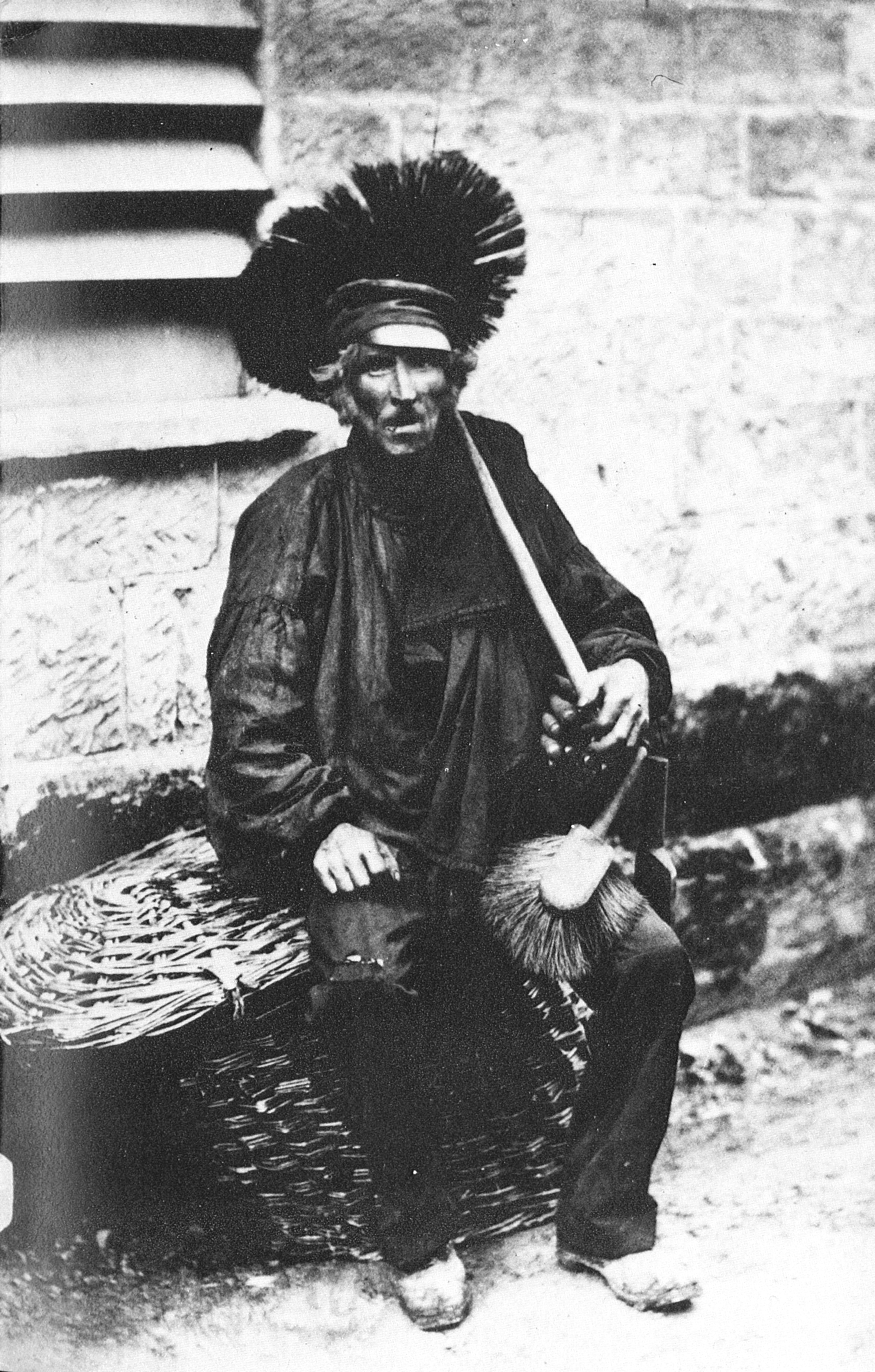
Chimney Sweep circa 1850


Posted by James

One day last week I came home to find a yellow notice affixed to the window on the entry door to our apartment building. It read:

                 Attention! Next week on May 21 the chimney sweep will be inspecting the combustion
                appliances in your building. Please make sure someone is home to receive him.

The chimney sweep???!!! What is this all about? Is Dick van Dyke going to show up with his helpers and start dancing from the rooftops like in Mary Poppins?

Later that week, we received an email from our landlord requesting one of us be at home on that day so the paper could be signed saying that the chimney sweep had, in fact, been there.

During the 19th and early 20th century, chimney sweeps were kind of an adjunct to the fire department. Whereas the fire department put fires out when they started, the chimney sweep helped keep fires from starting by cleaning soot and tar out of chimneys. Perhaps for that reason, chimney sweeps are a symbol of good luck in Germany. It was dangerous work, though, and often done by children. Back in the 1800s, chimney sweeps in Germany wore all black clothing and a top hat. But one wonders what function a chimney sweep serves today? Our apartment has no fireplace or coal stove, just an on demand gas water heater that we share with the neighbors.

Like much else in Germany, the chimney sweep is an old institution that has been repurposed in the modern era. According to the notice, the chimney sweep would be measuring the CO2 emissions and pollution generated by our combustion appliances, and adjusting the burner if they showed any sign of deviation from nominal. Today in Germany, the chimney sweeps are not only helping ensure fires don't start, but are also on the front lines of the battle against climate change and energy waste. Though I suppose if we did have a fireplace, he would have cleaned out the chimney.

Since Renate was working from home, she received the chimney sweep when he arrived on Thursday. He asked her to turn on the hot water in the kitchen, checked out the on-demand water heater while it was running, asked her to sign a paper, then left.

And, yes, he was dressed in the traditional all-black clothing, but he wasn't wearing a top hat.


Source: wikipedia.com

Wednesday, May 20, 2015

More on the Lower Franconia Trip


As James already provided so much excellent information about our trip to Unterfranken, I'm only filling in some blanks - starting with the exciting drive to Obernburg. My brother-in-law generously let us borrow his 25-year-old Volkswagen Passat (the picture above is actually from the Internet). A true classic, this car did not have such borning conveniences as power steering, but it was a stick shift. I did the driving, and after getting used to it, I actually enjoyed the drive quite a bit! Yes, a lot of construction was going on but we were driving on Thursday and Sunday, so traffic was fairly light. And on Sundays, trucks are not allowed on the Autobahn.

Entrance to toilet at rest stop

A curious experience was the stop to use the toilet. It involved paying 70 euro cents and going through a gate - rest stop staff was available to explain the technology (many of the travellers in need of the facilities were 60+ and not tech savy). After enjoying the spotless toilet, one could redeem 50 euro cents of the fee for goods at the shop or cafeteria. However, the thought of replacing the liquid and having to pay another 70 euro cents per person was not appealing, so we pushed on and were happy to arrive at our good friend's house in Obernburg.

Fachwerkhouse and modern building

On our first day in Unterfranken, we took a trip to Aschaffenburg to be tourists and later have dinner with a friend. Aschaffenburg was the big city when I was growing up and I took bi-weekly trips by train up to the library as a teenager - the small town where we lived did not have one, and getting my book fix was a life saver.

It's still an attractive place, with a fascinating mix of old and new, as the picture above can attest. I generally enjoy this contrast of different architectures. After all, old churches and castles usually have layers upon layers of remodelling and additions. They might start gothic, then have a baroque addition, a little altar with rococo elements, then a neo-classical remodel.

We also enjoyed the fountain in front of the Stiftskirche, which was decorated with eggs and greenery.  This tradition of decorating fountains for Easter has been revived throughout Franconia.

Stiftskirche fountain
Our friend had recommended that we visit the Stiftskirche museum, and we were not disappointed. We were almost the only people there, but it was a very worthwhile visit. Starting with stone age artifacts, the museum showed pottery, jewelry, and other signs of civilization throughout the ages. Everything had been found in the surrounding areas - and, interestingly, most of the excavations had happened after I had left the area. I was truly surprised how rich the history of the area was.

On the top floor we enjoyed the Magdalenen altar. Especially interesting was that the altar could be folded up, the inner panel was made visible only on high feast days.

The Museums of Aschaffenburg website has great information about the Stiftskirche museum in German, French, and English for those who are curious or want to visit one day. 

Madgalenenaltar, Stiftsmuseum Aschaffenburg
 After spending quite a bit of time in the museum, it was time for some refreshment and we had an excellent ice cream sundae (each). It was a busy time in Aschaffenburg - our friend had already warned us that the City Race was going on. Starting in the early afternoon with the smaller children - who ran a fairly short distance - the race graduated to teenagers and adults later in the day, ending with professional athletes after dark.

Blaskapelle to encourage the runners


The atmosphere was festive, with music everywhere. Parents strolled home (or back to the car) with their slightly sweaty children, as their older brothers or sisters, or maybe the parents, were warming up. It was altogether more casual than a race in the US, and I liked the emphasis on having the kids have a good time (many splashed through a fountain where we sat, walking home wet and happy).

We had an excellent dinner with our friend and left after dark to be well rested for the next day with the class reunion.  Too bad we didn't make it into the splendid castle - maybe next time....

Schloss Johannisburg (Aschaffenburg)

Monday, May 18, 2015

Obernburg

Alms Tower in Obernburg am Main
Posted by James

Last week I posted a bit about the start of our trip to Lower Franconia. This week I want to talk about Obernburg,  the little town in which we stayed. Obernburg has a long and quite interesting history, starting in Roman times and running through the Middle Ages to the present. At the head of the post last week I had a picture of the town gate, technically called the Clock Tower, for the fine gravity-driven clock that still works near the top. Obernburg was a walled town during the Middle Ages but unlike its more famous cousin Rothenburg ob der Tauber the wall was opened during the 19th century. Here you can see a part of the wall that's still standing leading back from the Clock Tower:
You can see the so-called Pocket Tower ("Taeschenturm") the smallest of Obernburg's six towers at the end of the alley. Above at the head of the post is the Alms Tower, which was built in the 2nd half of the 14th century and remodeled in the 1st half of the 16th century. We didn't manage to get any pictures of the other 3 towers, the Witches Tower ("Hexenturm"), the Round Tower, and the Stork's Nest, but you can check them out here (German).

Many of the houses in Obernburg are fackwork, wooden beams with either lime and straw filling or stone. The beams typically form a pattern on the outside of the house. Below you can see one that was build in 1480:


That was 12 years before Columbus came to America.

 Some of the shops have iron signs indicating what they sold:
This sign is for a butcher shop.

But Obernburg's history is considerably older. In 83 AD, the Romans built a fort, technically called a Castrum, on the site of Obernburg. The fort was overrun by the Germanic invasion in 259, but was rebuilt and strengthened later. The fort was staffed by soldiers from Aquitaine, the region of France on the Atlantic coast in the southwestern part of the country against the Spanish border. When the Obernburg fort was rebuilt, the Romans built a chain of forts running along the Main river, and turning into the Oldenwald around Woerth, where Renate grew up. These forts were called the Limes and were connected by a paved road suitable for goods transport. On one side of the border (the Main river here) were the wild German tribes, in which warriors lounged around all day while the woman, children, and old people did all the work. On the other, were the hard working Roman troops and civilians who were there to make money off of cross border trade. Occasionally, the Germanic warriors probably traveled over to the other side of the border, to the civilized Romans where they probably drank and raised hell. The Roman troops, called beneficiarii, had the difficult task of keeping the peace and often they probably ended up dead, like the sheriff in a town in the Old West.

We visited the Roman museum in Obernburg, and saw a collection of stones dedicated to the Roman god Jupiter in thanks, which the beneficiarii offered regularly every six months .... if they were still alive:
Hundreds of these stones were found in Obernburg. Sometimes Jupiter got an even fancier offering, like this column outside the museum, unfortunately only a replica because the original was taken to Munich:
There are so many Roman artifacts buried under Obernburg, that every time an old building is torn down and a new building is put up, the archeologists have to spend three months sifting through the dirt if the foundations are re-dug. Here's a picture of a construction site on the main street. You can see the little white tags where the archeologists marked the ground along the sides of the foundation hole to indicate that something of interest continues off the foundation site:
 

Finally, we visited the Annakapella (Chapel of St. Anne), a beautiful Baroque chapel which lies next to a cemetery, dedicated to St. Anne. The area was a hotbed of activity, as town residents were busy sprucing up the grave sites after the long winter, for Mother's Day, which was the next day. I couldn't resist taking this picture of St. Anne on the inside of the chapel:
If you look closely, you can see she has two eyes on her left hand. St. Anne was reputed to help people with eye problems. The statue reminded me of one of my favorite Tibetan painting subjects, which has a small eye in each of his one thousand hands.

Sunday, May 17, 2015

Looking Up

Saint on top of Santa Anna chapel in Obernburg
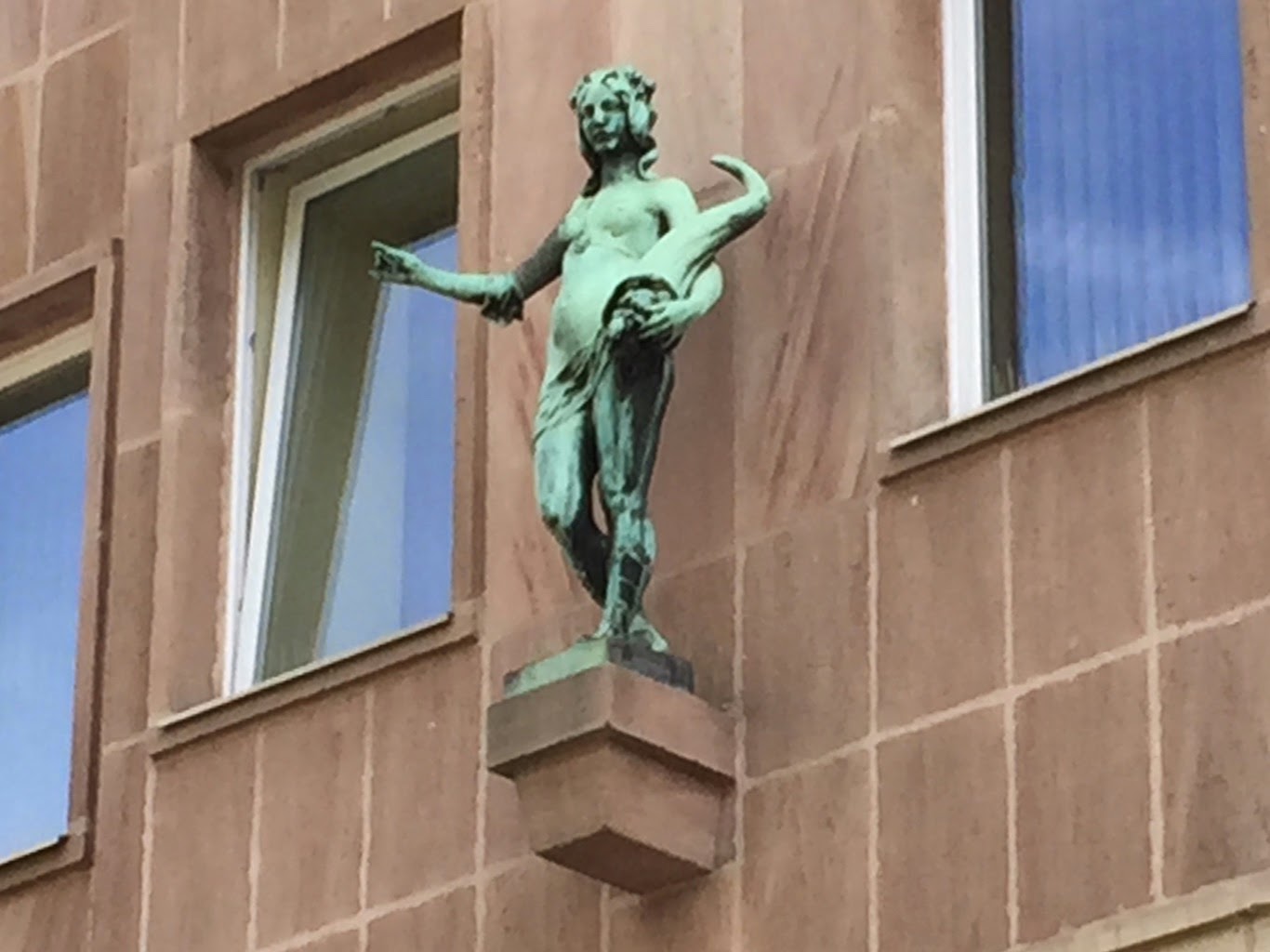
During our trip to Franconia, I was especially struck by the many things you could see while looking up. Even though at Middle Franconia is now protestant, south Germany in general has been catholic for longer and you see saints and other figures tucked away everywhere. Above, a female sent whose name I forgot on top of the Saint Anna chapel in Obernburg. She holds a snake, fairly unusual.

Several Choerlein in Nuernberg

Another Looking Up sight are the many Choerlein, small or large chancels, that are typically found especially in Nuernberg. There's a whole web page devoted to them. The Choerlein were ostensibly used as small chapels starting in the 15th century. However, many of the wealthy merchants used them primarily to show off. Other ornamentation of houses was restricted to the noblemen, so the merchants used the Choerlein as the BMW (or Porsche) of the day.


Once I started looking up, I couldn't stop. Sculptures large and small were everywhere. Some of them old, some of them quite new. 


I should add that this is a city phenomenon - the two-story houses commonly found in small towns or villages don't have sculptures (instead, you can find small altars at various places, especially in southern Germany).


Strangely, the sculptures don't necessarily have a lot to do with the shops that are on the ground floor of the houses - above, a sculpture at the pharmacy house.


And here, a very impressive St. George and the Dragon very close to the Nuernberg castle. Note the little roof above St. George's head. Even in churches the sculptures of saints always have a roof, mere mortals don't get roofs.


As is illustrated also by this beautiful sculpture of (I think) Mary at the second floor level of a store that sells traditional clothing (Trachten) in Nuernberg.

I'll keep looking up - and we'll find that looking up in Berlin, a much younger city, will yield different results. 

Friday, May 15, 2015

Trip to Lower Franconia


Medieval Gate in Obernburg


 Posted by James


Last week, Renate and I did a trip to Franconia to visit with our brother-in-law in Nuremberg and to attend Renate's high school class reunion in Erlenbach. Whether the trip would go forward at all was a bit touch and go. The locomotive engineers declared a strike, the third time I think since the beginning of the year, due to a power dispute and a dispute about time off. But the Deutsche Bahn arranged for substitute trains, and we took one over Hannover to Nuremberg, where our brother-in-law lives.

On the way to the train station by taxi (since the S Bahn was only running every twenty minutes due to the strike) we saw this young woman standing out in the middle of the street performing a juggling act in front of cars waiting for a traffic light to turn green:

which seemed kind of a prototypical Berlin Moment.

The trip took about an hour longer than expected, with an hour layover in Hannover. Along the way, we had a good look at evidence of Germany's "Energiewende". Germans call the time in 1989-1991 when the Berlin Wall came down and the two halves of German reunited "Die Wende", the Change or the Transformation. In 1988, nobody ever thought it would be possible for Germany to reunite, even though it was a dream of the people on both sides since the end of WWII and even enshrined in the West German constitution. In the early 2000s, the government decided to apply the same principle to energy, and so called it "Die Energiewende", the Energy Transformation. Germany now gets more than 30% of its energy from renewable sources, many of them wind machines like these along the train route in north Germany:
You see wind machines everywhere out in the countryside, and solar panels on many people's roofs. While some people don't like what the wind machines do to the views of the landscape, before the wind machines went up, there were factory smokestacks in towns and of course the ubiquitous power pylons everywhere. Climate change isn't a political issue in Germany, the only political issue has been how to address it, in particular whether Germany's nuclear power plants should be shut down. That was settled when the two reactors at Fukushima melted down in 2011, and now the plan is to site wind machines in the North Sea and run DC power lines (to reduce losses) to south Germany where much of the industry is located.

The Energiewende is still a work in progress. Brown coal power plants have made a comeback because they are the only kind of fossil fuel power that is cheap enough to compete with renewables. Unlike the US, gas comes from Russia and is typically only used for home heating and industrial heat. But the important point is that German society has made the commitment and the necessary laws and regulations are being put in place as needed. The laws and regulations shape the business and economic environment to slowly move German society away from fossil fuel and towards renewables.

In Nuremberg, we stopped briefly to borrow a car from our brother-in-law and say hi to one nephew, who was headed out for a month on an auto rally. Then we drove to the lower Main River Valley, or Lower Franconia as it is known ("Unterfranken" in German). Franconia (Upper, Middle, and Lower) is the most southern part of the state of Bavaria, and the Franconians are always complaining about the Bavarians: all the money goes to Munich and Upper Bavaria, the nicest archeological finds are spirited away to the Munich museums, and so forth. Franconians have their own dialect and their own foods ("Schauefle", pork shoulder with the bone still in it, special kinds of pretzels that are about half as big as the typical German pretzel, and also Nuremberger bratwurst, while the Bavarians have weisswurst ) and are in many ways different from the Bavarians. But when you suggest to them, why don't you follow the Scottish example and petition the federal government to become a new state, they inevitable demur and say that it doesn't make economic sense.

Renate attended high school in Erlenbach, a small town on the lower Main river. Technically the high school was a Gymnasium in German, not a hall with exercise equipment as in the US but a high school strictly for college preparatory students. Students on other tracks went to other high schools. We stayed overnight with an old friend of the family in Obernburg, an old medieval town on the opposite side of the river from Erlenbach:
Part of the reunion involved a tour of the Gymnasium, led by the current director. The school was about to be half torn down and rebuilt to accommodate more students. As the current building was still under construction during the first year that Renate attended, this was an opportunity for the graduates to see it one last time before it disappeared. The alumni were even offered the opportunity to get a piece of the old building, like people did with the Berlin Wall. I enjoyed the tour as it gave me an opportunity to compare a German Gymnasium to an American high school as I remembered it. The most striking thing was the complete lack of any sports facilities. German high schools don't have nearly the amount of extracurricular activities that American ones do, and they especially don't have any sports teams associated with the school. Physical education classes are part of the curriculum, but the activities are carried out on facilities outside, and the classes are only one hour a week.

The reunion itself took place in a small tavern. Only about 10 people were there, and some of them were interviewed by current students of the Gymnasium who were participating in an oral history project. Several of the former classmates were already retired, mostly unwillingly, and some where still working at side jobs but most of them still worked full time. In Germany, people in Renate's age group need to work until 66 before they can start drawing a state pension. In America, people in our age group can draw Social Security at a reduced payout rate at 62 1/2, but as in Germany, the full payout is only at 66.

We left around 8:30 for the trip across the river back to Obernburg.
Father's Day in Germany


Posted by James

Yesterday was Father's Day in Germany, which is the same day as Ascension Day ("Christihimmelfahrt" in German, direct translation would be "Christ conveyed to Heaven by means other than walking or riding an animal"). Ascension Day is a Christian holiday but in Germany also a public holiday when the banks are closed and everyone has off. The weather was cold (in the high 40's low 50's F or around 10C) and cloudy, with light fog and drizzle in the early morning, but by noon things had improved enough that we could do a bike ride. We rode to Wannsee, a small town still part of Berlin near a lake.

In America, Father's Day is a sedate affair and is celebrated on the third Sunday in June. Kids give their father's gifts; the family goes out to eat or visits with the grandparents. It's like Mother's Day, which is celebrated in Germany on the same day is in the US, on the second Sunday in May. But Father's Day in Germany isn't like that. While in America Father's Day is, like Mother's Day, a chance for kids to honor their parents, in Germany Father's Day is about male bonding.

On the Kronprincessinnenweg bike trail, we met groups of guys of all ages riding bicycles with their back baskets filled with beer. In a couple cases, we saw groups with small trailers filled with beer and boom boxes, and passed a couple groups that were partying along the side of the bicycle path with boom boxes blasting. The handlebars of some of the bicycles were decorated with leafy branches, and some guys wore funny hats. One guy even had on a Santa Claus cap. When we arrived at Wannsee, there was a small fair going on, and the parking was dominated by motorcycles. We saw a few women along the bike trail, and one couple, but that was about it.

We spent about an hour or so at the Wannsee Lake, checked out the beach, still closed because the weather hasn't warmed up enough to swim yet. Then we had lunch at a nice resturant, the Wannsee Terresse. Afterward, we walked down toward the lake. There were a lot of small sailboats and a stiff wind, and a couple kayakers, but no wind surfers. The weather wasn't all that great for wind surfing, unless you wore a wetsuit.

On the way back, the groups partying alongside the bike trail were noticeably more inebriated. But we were also passed by a couple groups of guys wearing spandex and pumping hard, no beer in evidence, probably hard core bicyclists that rode for sport. We arrived home around 3:30, having completed the 32 km (20 mi) round trip in about two hours, not including the hour we spent having lunch.


Image from https://lincolnsquarecc.files.wordpress.com/2012/06/vatertag_ballons_bm_249187a.jpg

Wednesday, May 13, 2015

Berlin Botanical Garden

Botanical Garden Entrance

Because of a trip to my former home in Unterfranken we've fallen behind on blogging, but I want to show some photos of our visit to the Berlin Botanical Garden before we tell you more about the trip.

The Berlin Botanical Garden features one of the most important collections of plants  in the world.  It's part of the Freihe Universitaet Berlin, and includes research areas, a library, a database of plants, and a large museum which costs extra. But it's also stunning, welcoming, and great fun.

We rode our new bikes to Dahlem and found out the hard way that you can't use the turn-by-turn instructions in traffic -- we kept missing what the nice Google Maps lady said and had to stop again and again to check the map. But eventually we arrived, locked our bike against the fence, paid a very reasonable entrance fee, and were on our way.

The botanical garden includes areas that are very natural-looking, others that are habitat replication, and special areas such as medicinal plants. Large conservatories, some for research and others open to the public, are shown on top of the map.


We started in the forest area, which included both a mixed deciduous forest and a birch forest.

German Forest 
It was a perfect time to go - everything was fresh and the young green was so shiny. Delicate wildflowers were scattered throughout the forest floor. The biggest surprise was the fox - yes, suddenly a big red fox came trotting along the path as if it lived here - and indeed, foxes are not rare in this city.  We fumbled with our phones and James managed to snap a picture. It was too amazing for words.
Fox in Botanical Garden
After this wonderful surprise, we walked on to see some of the plants that are typical of German wetland areas. Both nutrient-rich wetlands and nutrient poor wetland were represented (how do they do this??). 

Nutrient-Poor Wetland

Fiddleheads in Nutrient-Poor Wetland

Nutrient-Rich Wetland
I still knew many of the plants from when I was a little girl - but I didn't know the names or the details that I would know if I were looking at California native plants. So much to learn!

Next, we visited the Apothecary Garden - As I mentioned in my Farmer's Market post, Germans like to use medicinal herbs either as tea or as tinctures or salves for minor (or even major) ailments. Apothecary gardens have been important for centuries. The plants in this garden were organized according to problem area (digestive remedies, pulmonary remedies, etc.) and many of the plants were potentially toxic - but used in the right dosis they can really make a difference!


From there, we moved "inward" toward areas with full sun where rocky earth had been mounded to show off plants from Greece or other mediterranean countries. 

Mediterranean Flora
Rocky mounds also showed off alpine flora which included a fairly common Primula veris and Pulsatilla vulgaris.

Alpine Flora
At the edge of the mounds was a desert-like area with the most extraordinary tulips - was this where they originally came from? 


I could have stayed forever and enjoyed the many different plants, information about them, sounds, smells... But we had something else planned for later in the day and made our way back toward the conservatories. On the way, we enjoyed the more park-like setting that included a culinary herb garden and stunning flowering trees. 


Then we started our exploration of the conservatory, which has not only rain forest plants but also desert plants and carnivorous plants. 

Conservatory
Of course we especially enjoyed the mediterranean plants which reminded us of home, but it was a wonderful and well-labeled exhibit no matter where we looked.


Time went by much too quickly and I was sorry to go home. We only got lost a little bit on the way back and agreed that we were ready for the next adventure! More about that soon...